Best Anxiety Journals & Guided Journals (2026): Find the Right One for You
Quick note: This article contains affiliate links, which means I may earn a small commission if you purchase through them, at no extra cost to you. I only recommend products I've researched and genuinely believe can help. Your trust matters more than any commission. As an Amazon Associate, I earn from qualifying purchases.

Most anxiety management tools work on your body. Weighted blankets apply pressure. White noise machines calm your nervous system through sound. Acupressure mats release physical tension. They're all passive - you use them and they do their work. Best Weighted Blankets for Anxiety and Sleep
Journals are different. They're an active practice, and that's precisely what makes them valuable in a way no physical tool can replicate. Writing about anxiety externalizes it - moves it from the swirling, overwhelming inside of your head onto a page where you can see it, examine it, and respond to it with some distance. The thoughts that feel enormous and all-consuming when they're inside you often look smaller and more manageable when they're written down in front of you.

The challenge is that Amazon is full of journals, most of which look similar and claim to do the same thing. The real differences - between a gratitude journal and a CBT workbook, between a 12-week structure and a yearlong commitment, between a journal written by a psychologist and one written by a lifestyle blogger - matter enormously for whether you'll actually use it and whether it'll help with your specific type of anxiety.
Seven genuinely different journals are covered here, each approaching anxiety from a different angle, so you can choose based on how your anxiety actually works - not just which cover looks nicest.
Does Journaling Actually Help with Anxiety?
Yes - and the research behind it is stronger than for many popular anxiety interventions.
The foundational research comes from psychologist James Pennebaker, whose decades of work on expressive writing established that writing about difficult emotional experiences produces measurable improvements in psychological and physical health. Participants who wrote about traumatic or stressful events for 15-20 minutes over several days showed lower anxiety levels, improved mood, and even improved immune function compared to control groups. The mechanism: writing forces you to construct a coherent narrative around your experience, which engages your prefrontal cortex - the rational, problem-solving part of your brain - and reduces the dominance of the amygdala, the threat-detection center that anxiety keeps in a state of constant activation. This is the same dynamic at the heart of nervous system regulation: when the prefrontal cortex comes online, the fight-or-flight response dials down. What the Vagus Nerve Actually Does
Gratitude journaling has its own strong evidence base. A 2003 study by Emmons and McCullough found that people who wrote weekly about things they were grateful for reported higher well-being and lower anxiety compared to those who wrote about daily hassles or neutral events. Gratitude practice works for anxiety specifically because it redirects attention from future-focused worry (what might go wrong) to present-focused appreciation (what is already good) - directly counteracting anxiety's core cognitive pattern.
CBT-based journaling - the thought records and cognitive restructuring exercises in journals like Worry for Nothing and Goodbye Anxiety - has the most clinical support of any journaling approach. Cognitive Behavioral Therapy is the gold-standard treatment for anxiety disorders, and the journaling component of CBT produces measurable changes in anxiety when practiced consistently.
One honest note: journaling works best as a complement to other anxiety management strategies, not as a standalone treatment for clinical anxiety. If your anxiety significantly interferes with daily functioning, journaling is a valuable tool - but professional support matters more.
The 5 Types of Anxiety Journals
Knowing which type of journal matches how your anxiety actually works matters more here than in almost any other product category. Buying the wrong type isn't just a waste of money - it actively puts you off journaling because you're using an approach that doesn't fit.
- Daily guided journals provide short, structured prompts for morning and evening use - typically 5-10 minutes. They build a consistent daily habit without overwhelming you. Best for people who want to start a journaling practice and need low-pressure, achievable structure. The Five Minute Journal is the best example.
- CBT-based journals and workbooks use cognitive behavioral therapy techniques - thought records, evidence examination, cognitive restructuring - to identify and challenge anxious thought patterns. They require more time and engagement per session but deliver more clinical depth. Best for people who want to understand and actively change their anxiety patterns rather than just manage them day to day.
- Gratitude and mindfulness journals redirect attention from worry toward appreciation and present-moment awareness. They don't directly address anxiety - they shift the cognitive focus that feeds it. Gentler approach, lower pressure, better for mild anxiety or as a complement to other strategies.
- Structured program journals provide a defined timeline - 12 weeks, 52 weeks - with a progression of exercises and themes. Best for people who want accountability and measurable progress over time rather than open-ended daily practice.
- Creative and reflective journals use diverse prompts - drawing, movement, imaginative exercises alongside writing - for people who find traditional journaling dry or who resist purely written formats. Put Your Worries Here is the best example on this list.
How to Actually Use a Guided Journal
More important than which journal you pick is what consistent use actually looks like.
- Morning vs evening. Morning journaling sets an intentional tone for the day and works best for gratitude and goal-setting styles. Evening journaling processes the day's experiences and is better for anxiety that peaks at bedtime or shows up as racing thoughts at night. Many journals use both. Choose based on when your anxiety is worst. How to Stop Your Mind From Racing at Night
- Time commitment matters. Five minutes daily is achievable for almost everyone and produces results if done consistently. Thirty minutes of CBT worksheets three times a week requires more activation energy but delivers deeper work. Be honest with yourself about what you'll actually do rather than what you aspire to do. Starting with five minutes and building is always better than starting with thirty and quitting.
- What to do when you miss days. Missing days is normal and not a reason to quit. What matters is returning quickly. A useful rule: never miss two days in a row. One missed day is an accident. Two starts to become quitting.
- Writing style. There is no wrong way to journal. Bullet points, incomplete sentences, illegible handwriting - none of it matters. The benefit comes from putting thoughts into words and examining them, not from the quality of the writing. If you feel pressure to write well, it'll prevent you from writing honestly, which defeats the purpose.
- Privacy. Some people find it harder to write honestly if they're worried about someone reading their journal. Choose a journal with a discreet cover (Worry for Nothing specifically addresses this) or keep it somewhere private. The more honest you are, the more useful it becomes.
Quick Comparison Table
| Journal | Type | Structure | Best For | Price |
|---|---|---|---|---|
| Five Minute Journal | Daily Gratitude | Morning + Evening daily | Beginners, daily habit building | $25 |
| No Worries | Daily Guided | 12 weeks | Anxiety-specific daily structure | $9-$18 |
| Worry for Nothing | CBT Workbook | 60 repeating worksheets | CBT thought work, discreet cover | $15 |
| Goodbye Anxiety | CBT + DBT Workbook | Prompts + strategies | Clinical depth, dual approach | $17 |
| Corinne Sweet Anxiety Journal | Guided + Illustrated | Flexible | Portable, beautiful, CBT-light | $16-$19 |
| 52-Week Mental Health Journal | Year-Long Program | 52 weeks daily | Long-term commitment, broad mental health | $10-$18 |
| Put Your Worries Here | Creative/Reflective | 100 flexible prompts | Teens, creative thinkers, mixed formats | $15 |
7 Best Anxiety Journals & Guided Journals
The Five Minute Journal by Intelligent Change
Price
$25 (regularly $30)
Type
Daily gratitude journal
Structure
Morning + evening prompts, undated
Link
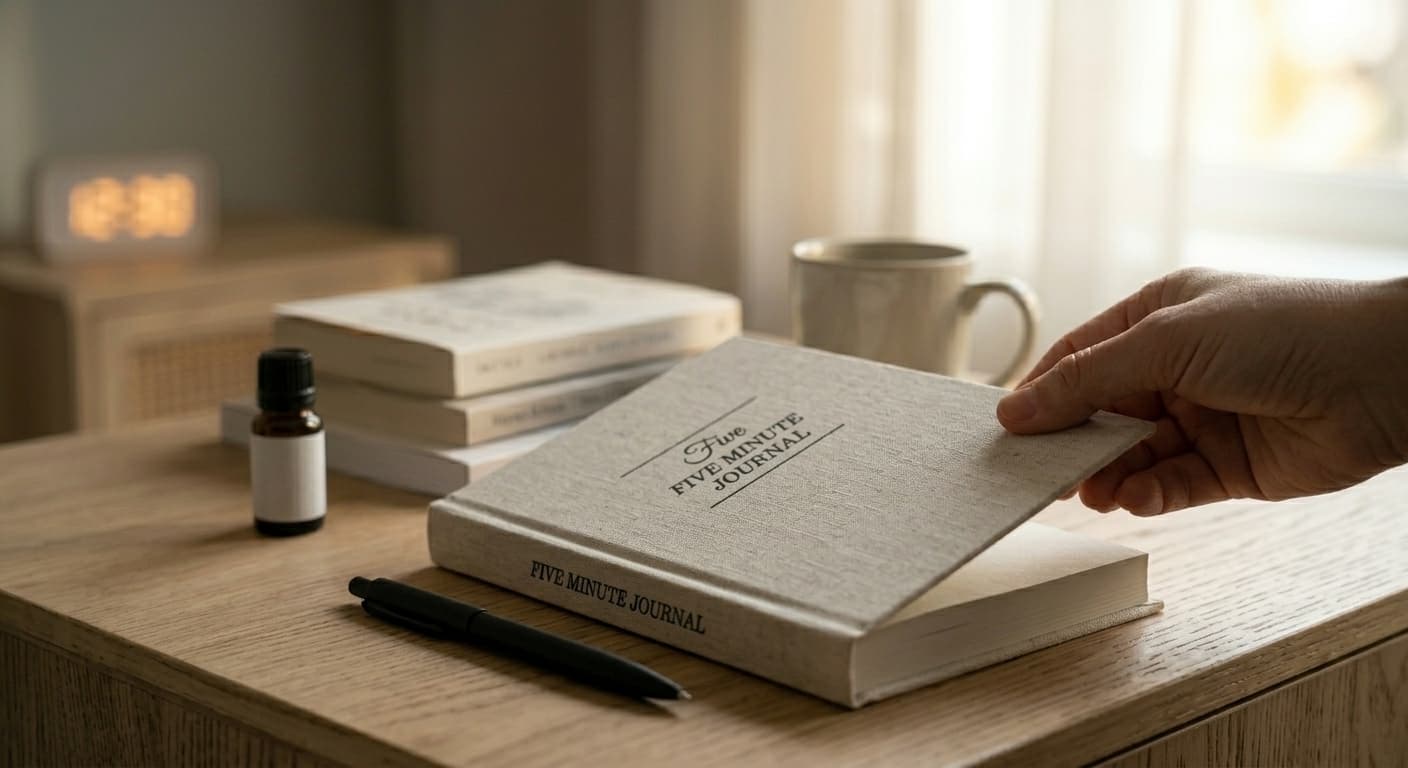
View on AmazonThe Five Minute Journal is the most popular guided journal on Amazon globally, and for good reason. The format is almost impossibly simple: three morning prompts (what are you grateful for, what would make today great, a daily affirmation) and two evening prompts (three amazing things that happened, how could today have been better). Five minutes. Done.
That simplicity is the point. Anxiety thrives on overwhelm. A journaling practice that requires twenty minutes of thoughtful writing is the one you'll skip when you're anxious, tired, or busy - exactly when you need it most. Five minutes is small enough that there's almost no valid reason to skip it, and consistent practice of even this minimal format produces measurable results over weeks.
The science behind it targets anxiety specifically. Anxiety is future-focused - it's worry about what might happen. Gratitude is present-focused - it anchors you in what is actually good right now. Practiced daily, this shift in attention gradually rewires your brain's default from threat-scanning to appreciation-noticing. Morning affirmations build the self-talk patterns that counteract anxiety's tendency toward catastrophizing. Evening prompts train you to notice positive experiences that anxiety tends to filter out.
The linen hardcover and sustainably sourced paper make this a journal you'll keep on your bedside table rather than shove in a drawer. The undated format means you can start any day without the pressure of catching up if you miss a session.
Pros
- 18,000+ reviews at 4.5 stars - the most validated journal on this list by a wide margin
- Five minutes daily - the most achievable commitment on this list
- Undated pages - start any time, no catch-up pressure
- Science-backed gratitude and affirmation approach
- Premium linen hardcover - genuinely beautiful to use
- 6 colour options
- Works equally well for anxiety, general well-being, and productivity
Cons
- Doesn't directly address anxiety - gratitude works indirectly, not through anxiety-specific techniques
- No CBT or DBT tools - for clinical thought work, you'll need something additional
- $25 is the most expensive journal on this list
- Some people find the positive-focus format feels forced during high-anxiety periods
No Worries: A Guided Journal
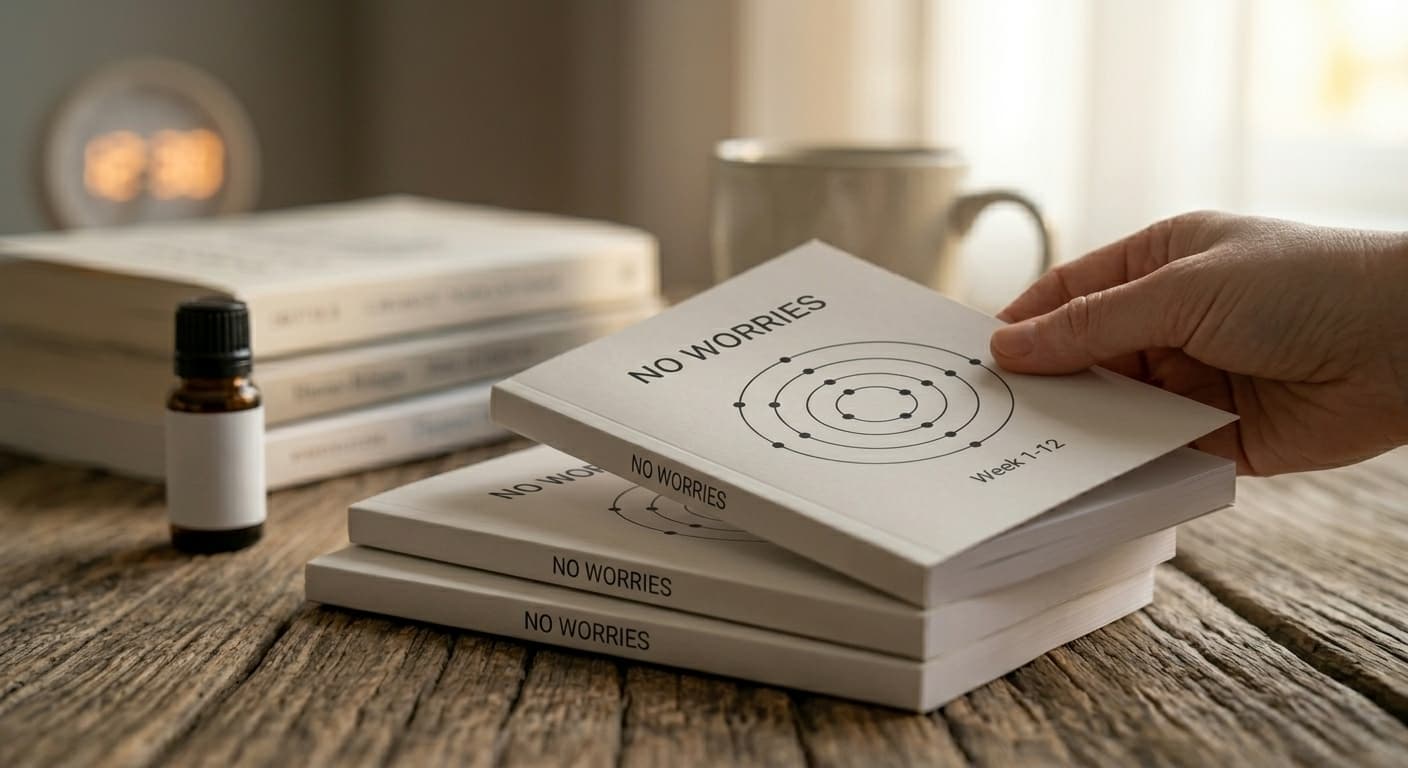
No Worries hits a specific and useful middle ground: more anxiety-specific than the Five Minute Journal, more accessible than a full CBT workbook. The 12-week structure gives you a defined arc - a beginning, middle, and end - which is particularly helpful for people who find open-ended journaling directionless.
Each daily page includes a mood check-in, space to reflect on anxiety triggers, gratitude practice, and room to note positive thoughts or moments. Weekly pages cover habit tracking and therapy reflections - if you're seeing a therapist, this makes the journal a direct extension of that work. Monthly progress pages let you look back and assess how your anxiety has shifted, which is one of the most motivating features for people who struggle with the slow, invisible nature of anxiety improvement.
The fear-setting exercises are a practical addition. Rather than just recording worries, the journal walks you through examining them: what's the worst that could happen, how likely is it, what would you do if it did. This is a worry-examination technique from cognitive therapy that's more action-oriented than standard prompts.
The paperback at $9 makes this the best value on the list.
Pros
- Anxiety-specific - every element designed for anxiety management, not general wellness
- 12-week structure - defined program with a clear beginning and end
- Multiple formats per page (mood, triggers, gratitude, positives) - comprehensive daily check-in
- Fear-setting exercises - practical worry examination beyond standard prompts
- Therapy reflection pages - integrates with professional support
- $9 paperback - best value on this list
- 3,300+ reviews at 4.5 stars
Cons
- Once complete, you need to buy another copy for continued use
- Lighter therapeutic depth than Worry for Nothing or Goodbye Anxiety
- Some prompts repeat frequently - can feel formulaic for longer-term users
Worry for Nothing: Guided Anxiety Journal & CBT Workbook

Worry for Nothing solves two problems at once: it delivers clinical-quality CBT thought work, and it does so in a journal that looks like a tasteful hardcover notebook rather than a mental health product. The cover doesn't spell out "worry" or "anxiety" - a deliberately discreet design choice that matters for people who journal in shared spaces, at work, or who simply don't want a wellness journal announcing their anxiety to anyone who walks in.
The format is based directly on the CBT thought record - the core tool that cognitive behavioral therapists use in clinical settings. Each two-page worksheet walks you through identifying the triggering situation, noting physical and emotional sensations, examining your automatic thoughts, evaluating the evidence for and against those thoughts, and arriving at a more balanced perspective. This is the actual therapeutic technique, translated into a self-guided format by therapists who use these prompts with their own clients.
Sixty worksheets means sixty complete thought-record exercises - enough for daily use for two months, or intermittent use over a much longer period. The 100gsm paper is a practical choice: thick enough for gel pens without bleed-through.
Pros
- CBT thought records - the gold standard clinical technique in self-guided format
- Therapist-backed prompts
- Discreet cover - looks like a regular notebook, appropriate for any setting
- 60 complete worksheets - substantial content for the price
- 100gsm paper - gel pen compatible, no bleed-through
- Same structure each time builds automatic habit
- 1,300+ reviews at 4.5 stars
Cons
- Repetitive by design - same worksheet format every time
- No variety of exercises - purely thought records, no gratitude or mood tracking
- Requires repurchase once complete
- No author credentials listed prominently
Goodbye, Anxiety: A Guided Journal for Overcoming Worry
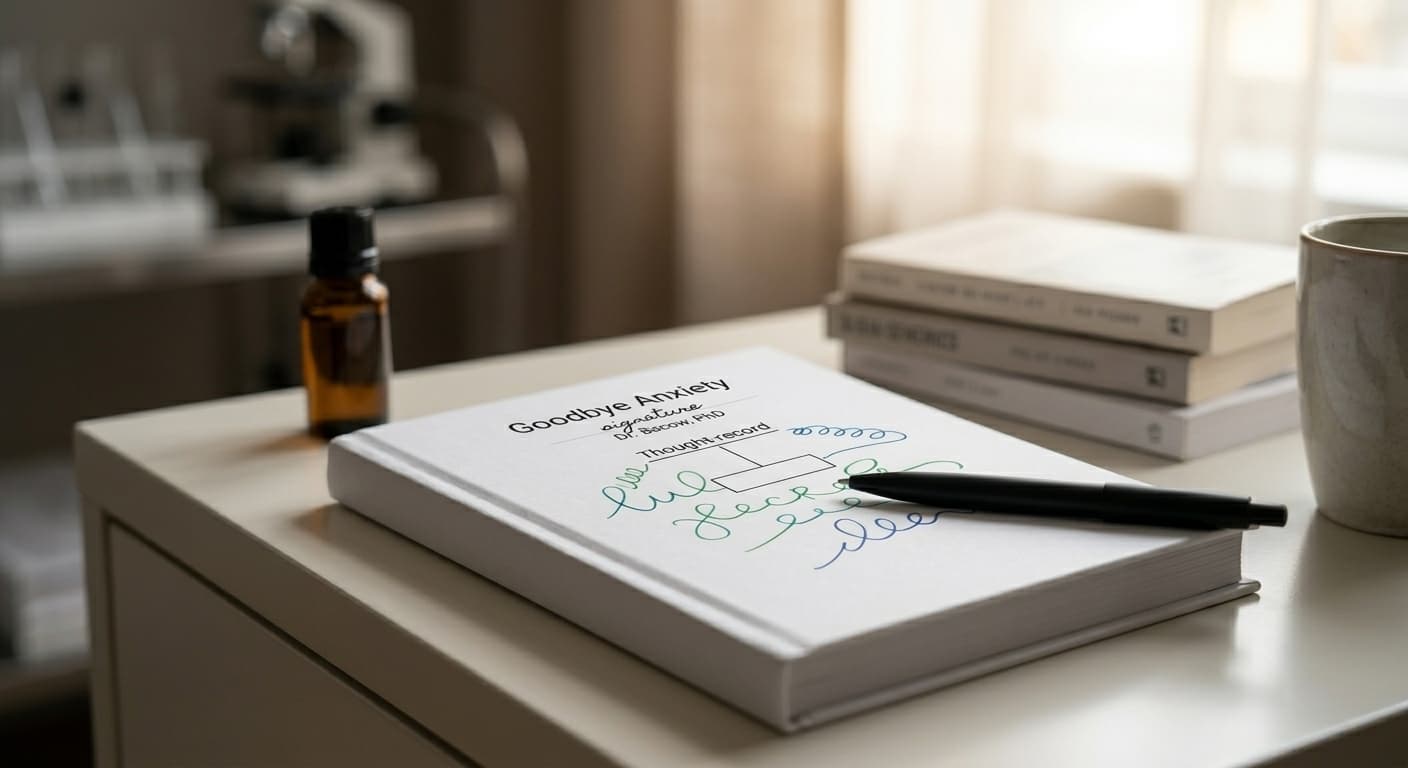
The credentials here are the differentiator. Terri Bacow is a clinical psychologist who specializes in anxiety treatment, and Goodbye Anxiety is endorsed by Lisa Damour PhD - one of the most respected psychologists working on adult and adolescent anxiety. The journal combines CBT (Cognitive Behavioral Therapy) and DBT (Dialectical Behavior Therapy) - two of the most evidence-based approaches for anxiety - in a self-guided format that makes these clinical tools accessible without requiring a therapist.
The scope is broader than anything else on this list: 100+ writing prompts, 40+ CBT and DBT strategies, and 50+ practical coping tools. Where Worry for Nothing focuses purely on CBT thought records, Goodbye Anxiety also incorporates DBT skills - distress tolerance, emotion regulation, mindfulness, and interpersonal effectiveness - which are particularly helpful for anxiety that has a strong emotional intensity or physical component alongside the cognitive patterns.
The low review count (93) reflects a more recent publication date rather than quality concerns. The credentials, endorsements, and clinical content place it clearly above most anxiety journals on Amazon regardless of review volume.
Pros
- Written by a clinical psychologist specializing in anxiety
- Endorsed by Lisa Damour PhD - significant credibility signal
- Combines CBT and DBT - the broadest evidence-based approach on this list
- 100+ prompts, 40+ strategies, 50+ tools - the most comprehensive content here
- $9 Kindle price - most affordable entry point for the clinical depth offered
- 4.6 stars - highest rated on this list
Cons
- Only 93 reviews - limited social proof compared to other journals here
- More workbook than daily journal - less suited to a 5-minute daily habit format
- Requires more time and engagement per session
- CBT and DBT concepts may feel unfamiliar without some background knowledge
The Anxiety Journal by Corinne Sweet

Price
$16-$19
Type
Guided and illustrated CBT-informed journal
Author
Corinne Sweet (psychologist and psychotherapist)
Link
View on AmazonCorinne Sweet is a psychologist and psychotherapist who has written fourteen books. The Anxiety Journal, beautifully illustrated by designer Marcia Mihotich, brings that clinical background into a format that prioritizes accessibility and aesthetics alongside therapeutic value.
The CBT techniques here are present but light - cognitive behavioral principles as a framework without requiring you to work through formal thought records or structured worksheets. Instead, it offers grounding facts about anxiety, mindfulness exercises, writing prompts that help identify anxiety causes and patterns, and lined pages for free reflection. The overall feel is supportive and calming rather than clinical and procedural.
The portable size is a deliberate design choice - small enough to carry in a bag and use wherever anxiety strikes rather than being a bedside-only object. For social anxiety, work anxiety, or anxiety triggered by specific situations away from home, this makes it uniquely practical. The heavy cover is built for repeated use in transit.
Pros
- Written by a practicing psychologist and psychotherapist
- Beautiful illustrations - the most aesthetically appealing journal on this list
- Portable size - designed for use wherever anxiety strikes, not just at home
- CBT-informed but accessible - therapeutic depth without clinical formality
- Heavy-duty cover built for on-the-go use
- 1,100+ reviews at 4.5 stars
Cons
- Less clinical depth than Worry for Nothing or Goodbye Anxiety
- No structured program or defined timeline - more flexible, less accountable
- Limited space for free writing
- Some readers find the exercises too brief for the depth they want
52-Week Mental Health Journal
The 52-Week Mental Health Journal is the only option here designed for a full year of daily practice. Where most journals offer 12 weeks or a set number of worksheets, this one provides a structured prompt for every single day of the year - organized across four core pillars: calm and resiliency, connection and engagement, goals and purpose, and healthy living.
This scope matters because anxiety doesn't resolve in 12 weeks. Real change in anxiety patterns takes months of consistent practice, and a yearlong journal provides the accountability structure to sustain that without needing to repurchase or restart. The progression through different themes prevents the repetition fatigue that shorter journals sometimes produce.
The methods are explicitly evidence-based - mindfulness and CBT techniques referenced throughout. Inspiring quotes from philosophers, artists, and writers appear across the year, providing perspective alongside the practical prompts. At its current price of $10, it's roughly three cents per day of guided practice - the best value per session on this list.
Pros
- 52 weeks of daily prompts - the longest commitment structure here
- Four core pillars provide thematic variety - prevents repetition fatigue
- Evidence-based methods (mindfulness + CBT) throughout
- 4.6 stars across 2,000+ reviews
- $10 current price - best value per day of content
- Covers anxiety as part of broader mental health
Cons
- Broad mental health focus rather than anxiety-specific - not every prompt targets anxiety directly
- Year-long commitment is motivating for some, overwhelming for others
- Less clinical depth than CBT-specific journals
- Returning after missed periods can feel daunting
Put Your Worries Here: A Creative Journal for Teens with Anxiety

Put Your Worries Here is clinician-recommended, published by New Harbinger - the most respected publisher of evidence-based mental health self-help resources in the US. Lisa Schab is a licensed clinical social worker with extensive experience working with teens, and also the author of The Anxiety Workbook for Teens.
The creative format is what sets it apart. Where every other journal on this list is primarily a writing journal, this one uses a mix of writing, drawing, movement prompts, laughter, and physical self-soothing techniques alongside traditional written reflection. This is deliberately designed for the teenage brain - which engages more readily with variety, creativity, and physical activity than with structured written exercises. The result is a journal that actually reaches teens who would put down a traditional format within a week.
The flexibility built into the prompts is notable: the author explicitly tells teens they can complete them in any order, skip ones that don't resonate, and repeat prompts they found useful. This non-prescriptive approach reduces the resistance that anxious teens often have toward therapy-adjacent activities, while still delivering the clinical content effectively.
Pros
- Written by a licensed clinical social worker specializing in teen anxiety
- Published by New Harbinger - the most credible mental health self-help publisher
- Creative format (writing, drawing, movement, laughter) - engages teens who resist traditional journaling
- Clinician-recommended - endorsed as an adjunct to therapy
- Flexible structure - teens can use it in any order, skip and repeat as needed
- 4.7 stars - highest rating on this list
- 100 diverse prompts - the most varied format on this list
Cons
- Specifically designed for teens - not the right choice for adults
- Creative format may feel too young for older teens or young adults
- Less structured than program-based journals - some teens do better with more defined routine
- 640 reviews - lower count than other options here
How to Choose the Right Journal
- Never journaled before, want the lowest-pressure start: Five Minute Journal ($25) - five minutes, beautiful format, no wrong answers.
- Want anxiety-specific daily structure with a defined endpoint: No Worries ($9-$18) - 12 weeks, covers triggers, mood, gratitude, and therapy integration.
- Your anxiety is driven by negative thought patterns you want to challenge: Worry for Nothing ($15) - CBT thought records, discreet cover, 60 worksheets.
- Want the most clinically rigorous approach combining CBT and DBT: Goodbye Anxiety ($17) - written by a clinical psychologist, the deepest therapeutic content here.
- Want something beautiful and portable for anxiety that strikes away from home: Corinne Sweet Anxiety Journal ($16-$19) - psychologist-authored, illustrated, carry-anywhere size.
- Want a full year of structured daily practice: 52-Week Mental Health Journal ($10-$18) - 365 prompts, four mental health pillars, best value per session.
- Buying for a teenager: Put Your Worries Here ($15) - creative format, clinician-endorsed, flexible structure teens actually engage with.
Guided Journal vs Blank Journal
For anxiety specifically, guided journals are almost always better to start with. Anxiety creates avoidance - the blank page of an unguided journal is an invitation to think about what to write, which for an anxious person often means thinking about anxiety itself in an unstructured way that can spiral. Prompts break this by giving your mind somewhere specific to go.
Once you've built a consistent journaling habit through a guided journal, transitioning to a blank journal with your own prompts becomes much more viable - and often more rewarding.
The Science of Journaling for Anxiety
Three evidence-based mechanisms explain why journaling consistently reduces anxiety.
- Expressive writing and affect labeling. When you write about an anxious experience, you engage the prefrontal cortex in a way that simply feeling the anxiety doesn't. Pennebaker's research shows that translating emotional experience into words produces what he calls "cognitive integration" - your brain constructs a coherent narrative around the experience, which reduces its raw emotional charge. Brain imaging studies confirm this: labeling emotions in writing reduces amygdala activation and increases prefrontal cortex engagement. You are literally thinking your way calm through the act of writing.
- Cognitive restructuring through CBT journaling. The thought record technique used in journals like Worry for Nothing and Goodbye Anxiety has decades of clinical research behind it. When you write down an automatic negative thought and systematically examine the evidence for and against it, you engage in the same cognitive restructuring that makes CBT one of the most effective anxiety treatments available. The key finding: writing thoughts down makes them more examinable and less overwhelming than keeping them in your head. Thoughts that feel certain and catastrophic when internal often reveal themselves as uncertain and manageable when written.
- Gratitude and attention training. Anxiety is characterized by a bias toward noticing and dwelling on threatening or negative information - sometimes called negative attentional bias. Gratitude practice systematically counteracts this by training you to notice and record positive experiences daily. Over weeks, this isn't just mood improvement - it's a gradual retraining of what your brain notices and prioritizes. Research by Robert Emmons consistently finds that gratitude practice reduces anxiety and worry symptoms over time through exactly this mechanism.
FAQ
How long should I journal each day?
Five to fifteen minutes is the sweet spot for daily journaling. Less than five minutes doesn't allow enough time for meaningful reflection. More than thirty minutes can feel burdensome and unsustainable as a daily habit. If you're using a CBT workbook style (Worry for Nothing, Goodbye Anxiety), sessions of 15-20 minutes three to four times a week work better than daily shorter sessions.
Morning or evening - which is better for anxiety?
Evening if your anxiety is worst at night or shows up as racing thoughts at bedtime - processing the day's experiences before sleep reduces the mental load that feeds nighttime anxiety. Morning if your anxiety is worst when you wake up - setting an intentional, grateful tone first thing prevents anxiety from hijacking the start of your day. Many journals (Five Minute Journal, No Worries) include both morning and evening components.
What if I don't know what to write?
Write that. "I don't know what to write right now. I'm feeling [blank]." This almost always breaks the block because naming where you are - even the blankness - is itself a valid journaling entry. Guided journals solve this more directly because the prompts tell you exactly what to write.
Can journaling replace therapy?
No. Journaling is a complement to therapy, not a replacement. If your anxiety significantly interferes with daily functioning, therapy is the most important step. Journaling makes therapy more effective and extends the work between sessions.
How do I know if it's working?
Look for three indicators over four to eight weeks of consistent practice: slightly easier sleep on nights when you journal; moments of noticing anxious thoughts earlier rather than being overwhelmed by them; and the occasional shift during a journaling session where a worry that felt large becomes more manageable through writing. These are subtle changes that compound. Monthly progress pages (in No Worries) or looking back at early entries often reveals more change than you noticed in real time.
What if I miss several days?
Start again the next day without guilt. Guilt about missing journaling sessions is itself an anxiety-feeding pattern. The goal is a sustainable long-term practice, not a perfect record. Undated journals (Five Minute Journal) eliminate the visual reminder of skipped dates. If you've missed so long that returning feels overwhelming, re-read a few old entries first - it usually motivates returning more than any fresh resolution.
Final Verdict
For most people starting out, The Five Minute Journal at $25 is the right choice. Eighteen thousand reviews at 4.5 stars is not an accident - this format works, and five minutes daily is achievable even on the worst anxiety days. Start here, build the habit, and evaluate after four weeks whether you want to add something with more clinical depth.
If you want anxiety-specific structure from day one, No Worries at $9 paperback is the best value here - a complete 12-week anxiety program covering triggers, mood, gratitude, and therapy integration for under $10.
For genuine CBT work on the thought patterns driving your anxiety, Worry for Nothing at $15 is the most practical choice - clinical technique, discreet format, sustainable habit-building structure.
If you want the deepest therapeutic content in a self-guided format, Goodbye Anxiety at $17 by clinical psychologist Terri Bacow PhD offers CBT and DBT tools at a level of clinical rigor nothing else here matches.
And if you're buying for a teenager, Put Your Worries Here at $15 - clinician-endorsed, creative format, genuinely designed for how teenage brains engage with anxiety.
Give whichever you choose four weeks of consistent use before judging it. One session shows you the format. Four weeks shows you what it does to the patterns underneath.
Reflections & Thoughts
No thoughts shared yet. Be the first to join the conversation.